When you buy through links on our articles, Future and its syndication partners may earn a commission.

For the first time in more than 50 years, humans are cruising through lunar space.
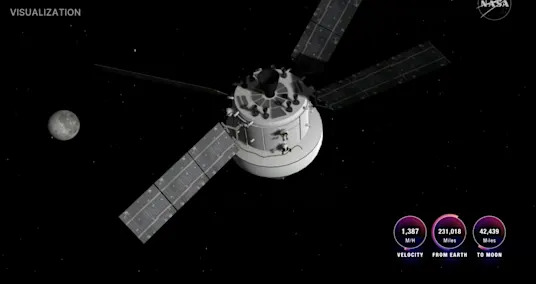
The four astronauts of NASA's Artemis 2 mission arrived in the moon's sphere of influence — the region where lunar gravity exerts a more powerful pull than that of Earth — today (April 6) at 12:37 a.m. EDT (0437 GMT).
The milestone occurred when the mission's Orion capsule was about 39,000 miles (62,764 kilometers) from the moon and roughly 232,000 miles (373,368 km) from Earth, a commentator said during NASA's Artemis 2 livestream.
The Artemis 2 astronauts — NASA's Reid Wiseman, Victor Glover and Christina Koch and the Canadian Space Agency's Jeremy Hansen — are the first people to cross the lunar threshold since December 1972, when the three-person Apollo 17 moon-landing mission did so.
Artemis 2 will not touch down on the moon, or even enter lunar orbit. Rather, Orion will loop around the moon's far side this evening in a history-making flyby. During that encounter, Artemis 2 will get farther from Earth than any crewed flight ever has.
The distance record is currently held by the Apollo 13 astronauts, who got 248,655 miles (400,171 km) from our planet in April 1970. At the height of tonight's flyby, just after 7 p.m. EDT (2300 GMT), Artemis 2 will be 252,757 miles (406,773 km) away from the rest of humanity, NASA officials have said.
The Artemis 2 astronauts will study the moon during the flyby, gathering data that could help scientists better understand the terrain and geology of Earth's nearest neighbor. They'll also be treated to a total solar eclipse, which will not be visible to those of us here on terra firma.
In addition, the flyby will chart their path home: Lunar gravity will slingshot Orion back toward Earth. Artemis 2 astronauts will come home on Friday (April 10), ending their 10-day mission with a parachute-aided splashdown off the coast of San Diego.
Editor's note: This story was updated at 1:15 a.m. EDT on April 6 with NASA's revised time of Orion's entry into the moon's sphere of influence — 12:37 a.m. EDT rather than 12:41 a.m. EDT.
LATEST POSTS
- 1
 'It's doing badly': Fears grow for whale stuck off Germany's coast
 - 2I binged all 24 Hallmark Christmas movies in less than 30 days. I emerged a changed man.
- 3Birds at a college changed beak shapes during the pandemic. It might be a case of rapid evolution
- 4The Latest: Fueling begins as NASA aims to send 1st crew to the moon in 53 years
- 5As cases of a rare, deadly infection rise, doctors worry fewer teens will get vaccinated




- 'Seditious behavior': Trump accuses Democrats who made video reminding the military not to follow illegal orders of a crime — but is it?
- Netanyahu leads meeting on West Bank riots, Katz defends axing administrative detention for Jews
- Building an Individual Brand: Illustrations from Powerhouses
- Winter virus season so far is not too bad, but doctors worry about suffering to come
- 75% of Arab Israelis support Arab party joining government coalition post-war, survey reveals
- SpaceX rocket launches 140 satellites into orbit on Transporter-15, aces landing at sea (video)
- The most effective method to Guarantee Scholastic Honesty in Web-based Degrees
- Check out the exclusive pitch deck Valerie Health used to raise $30 million from Redpoint Ventures to automate healthcare faxes
- 'Crammed into a cell with vermin at New Year'


